

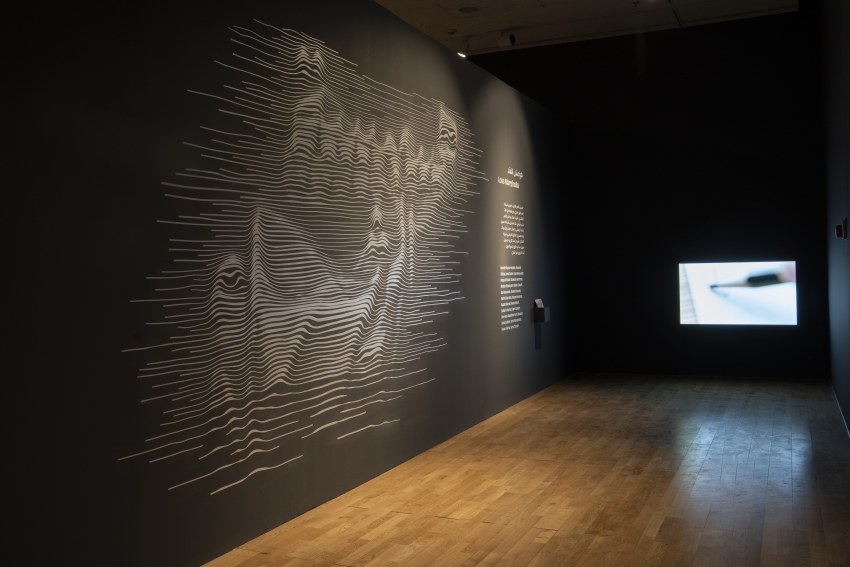
The A. M. Qattan Foundation inaugurated, on 16 May 2026, the exhibition Loss Marginalia at its premises in Ramallah. The group exhibition falls under the multifaceted project Elegiac Whispers, curated by Amin Alsaden, and brings together artists from Palestine and the Arab world and its diasporas.
The project invokes Arab grief not as a subject to be examined, represented, or displayed in the abstract, but rather revolves around it, as grief itself constitutes the methodology through which the participating works were conceived. Alsaden distinguishes between these two approaches, describing the works as “poetic,” insofar as they approach grief with intensity and profound sensitivity, attending to aesthetics while simultaneously grappling with this deeply complex and heavy subject.
The participating artists delve into loss much like poets do: the more they contemplate grief, attempting to grasp this elusive, ambiguous, and overwhelming condition, the more it slips through their fingers. Alsaden elaborates, “We must recognize that the contemporary reality of this region has been shaped by grief, following years and even decades of immeasurable losses, and we should confront this truth candidly.”
The exhibition presents a group of contemporary works spanning sculpture, embroidery, photography, video, drawing, and sound installation. Despite their varied materials and approaches, the works converge in their engagement with loss in this region with its unending sorrows. The works may be understood as “poetic marginalia scribbled around a gaping void, the losses that can never be recovered,” as described in the exhibition statement.
Among the exhibited works is Algerian artist Rachid Koraïchi’s elegy to friendship: a talisman born from a visitation dream in which his old companion Mahmoud Darwish lamented what his nation has been enduring. Installed outdoors on the Foundation’s terrace, the work is composed of stones gathered from Bisan, Tiberias, Jericho, and Birzeit, arranged into interlocking waves evoking the land’s shores. At its center lies a star containing Arabic letters, standing for the departed poet’s words. The work is an homage to Palestine and its great poet, created in solidarity.
Palestinian artist Reem Masri, meanwhile, embroidered her elegy to the mother nation onto a mourning veil inspired by her grandmother’s shawl, draped around a long dress until the two blend into one another. Running the length of the work is a hand-embroidered poem composed by the artist herself, lamenting the incessant cycles of rage, fear, and sorrow. Her work searches for the tenderness of Palestine, the mother nation, amid recurring catastrophes endured by its people.
Lebanese artist Nadim Choufi compiles an elegy to recollection inspired by the story of Palestinian poet Ali Foda, who awoke from a coma only to read the obituaries written by those who believed he had died. Choufi assembles an imagined auto-obituary from Foda’s earlier verses, whose strands merge to suggest the word “no” in Arabic, implying a refusal of death and of being forgotten. This is an elegy recycling other elegies.
Five artists from Gaza — Kholoud Hammad, Osama Hussain, Rawan Murad, Shereen Abedalkareem Hasanin, and Sohail Salem — present hand-sketches produced between 2023 and 2025 under conditions of siege and genocide, reproduced on postcards that visitors may take and circulate globally. The curatorial statement describes these works as “mementos of surreal circumstances, glimpses into unimaginable catastrophes.”
Alsaden notes, "Artists, like poets, are capable of approaching extremely difficult subjects through captivating and lyrical means, urging audiences to reflect and to carry those reflections with them. This is the subtle power of art and the significance of exhibitions in particular as impactful communal and cultural forums.”
The exhibition draws upon Arabic poetry as both a conceptual framework and a point of departure. Elegy, one of the oldest genres of Arabic poetry, traditionally opens with a specific image: stopping by ruins, employing lamentation over what has been lost not as a conclusion but as a prelude to what follows. The exhibition consciously echoes this structure; it does not seek resolution, transcendence, or consolation, but rather “reconciling with harrowing absences” as the beginning of a more profound understanding, one that “opens windows into a complex reality occluded by survival mechanisms", as Alsaden writes.
Within this framework, grief is not something to overcome but something to confront. The exhibition likewise reflects an understanding that mourning is not a luxury that can be postponed. As Alsaden explains: “Confronting our grief is a collective responsibility, and there is urgency in remembering what — and who — disappeared. We cannot wait until our wounds heal. Mourning is our right now, an ongoing act of resistance against erasure, a collective refusal to forget what is dear to us.”
The loss addressed by the exhibition accumulates across time: the loss of human lives, homelands, intimacy, language, ancestral practices, and the bonds between the communities of this region. Arab lands are saturated with grief at their core. Alsaden, speaking as an Iraqi hosted by Ramallah, believes that this accumulation calls for a collective consciousness: “Among us Arabs, there remains so much that is shared, and we must grieve the loss of those deep historical and cultural connections that generations raised under colonial borders unfortunately no longer fully recognise."
This acquires an additional layer of significance when considering that Alsaden — who received his doctorate in history from Harvard University and whose current research centres on solidarity — found in Ramallah an echo of his own experience. As he remarks, "I saw my own experience reflected in this land. My ongoing academic research revealed to me that Palestine has always been central to Arab collectivity — indeed, at the heart of the modern Arab world.”
Alsaden describes the project as “only a beginning.” He asks: “Where do we go from here, once we absorb these realities? Can mourning lay the foundations for another consciousness, for an alternative reality?” As in classical Arabic poetry, stopping by ruins was never an end in itself; what followed was always the principal subject. Loss Marginalia, therefore, poses the essential question: after pausing, where do we go next?
Loss Marginalia is open from 16 May 2026 until 28 January 2027 at the A. M. Qattan Foundation, Ramallah, Palestine. The project is curated by Amin Alsaden.
Participating artists: Vera Tamari, Hussein Nassereddine, Hussein Shikha, Ismaïl Bahri, Joe Namy with Maya Al Khaldi, Kholoud Hammad, Morjan Ghanayem, Nadim Choufi, Ola Hassanain, Osama Hussain, Rachid Koraïchi, Raisan Hameed, Rawan Murad, Reem Masri, Sadiq Al-Harasi, Sara Kontar, Shereen Abedalkareem Hasanin, Sohail Salem, Tarik Kiswanson, and Thana Faroq.